The
Dome.
On curvature, coming home, and why we build the way nature builds.
We are not built for corners. Nothing that's alive is.
I want to start this one somewhere unorthodox.
Think about the last time you felt truly at ease in a room, from the moment you walked in. I don't mean comfortable, like in the way a couch is comfortable. I mean truly at ease in the way your shoulders drop without you telling them to. Feel your shoulders now. Were they hiked up with a bit of tension?
If you're in that type of room, the comfortable room, it's likely that the room didn't corner you. It didn't press in at sharp angles or funnel you down a hallway toward somewhere else. It probably curved, or it opened, or it let you be in it without asking anything of you.
Candidly: we humans are not built for corners. “Nobody puts Baby in the corner.” Nothing that's alive is built for corners.
Look closely at anything nature makes…a seed, a shell, a cell dividing, the curve of a rib cage protecting a heart, and you will not find a single right angle. Nature does not build in straight lines. It builds in curves, because curves are how weight gets shared, how growth happens without breaking, how a structure holds itself up without any one part bearing more than it can carry. Somewhere in our bodies, we already know this.
It's why a circle feels like rest and offers a space of coming home to ourselves.
A man named Buckminster Fuller noticed this too, decades before we broke ground on anything. He spent his life asking a simple question: what if we built the way nature builds? His answer was the geodesic dome: a structure made entirely of triangles, locked together so that no single beam, wall, or point carries more than its share. It is, by design, one of the most efficient shapes that exists. You can enclose enormous space with very little material, because the structure is doing what a living thing does: distributing its own weight, everywhere, all at once.
That is the shape we chose for Oasis, because of what it lets a body do the moment it walks inside.
No corners to retreat into. No rigid hierarchy of front and back. Just a curve, holding you.
The dome's skin isn't ordinary glazing. It's polycarbonate, the same material greenhouses use, because we are, in a very real sense, building a greenhouse for people as much as for plants. It costs more than standard glass. It's worth it. It holds heat, insulates through a Charlotte winter, and lets a botanical world live inside the structure year-round, breathing alongside whoever's breathing beside it.
You will not see the mechanical systems that keep all of this alive. The HVAC runs entirely beneath the ground so there's no visible ductwork, no units competing with the plant life for your attention. The building breathes underneath you, quietly, so that everything you actually see and feel is the garden, the light, the curve of the walls holding you rather than boxing you in.
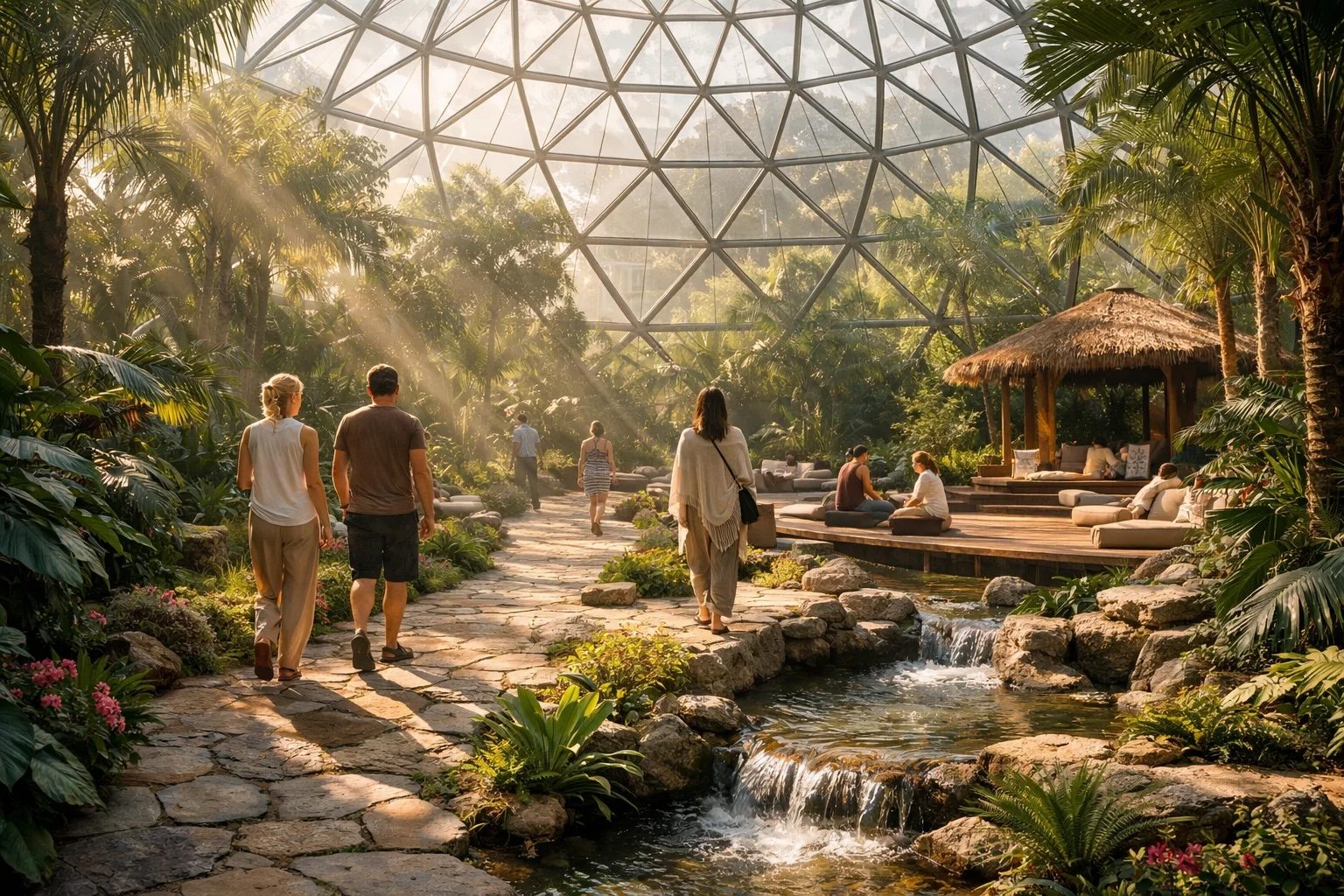
And the shape doesn't stop mattering once you're inside it. The whole path through Oasis is designed as a circle, not a hallway. You enter, and the path pulls you left first, toward a tea lounge, which is a place built for nothing but slowing down before anything else happens. From there you move through the elemental spaces. Then into an integration lounge, to sit with whatever surfaced along the way. And then the path brings you back outside, having moved in a full circle rather than a straight line in and out.
Walking through it is meant to feel like walking through a larger version of yourself. The same questions we're all quietly carrying, like what heals us, what holds us, and what carries us, built into the very shape of the floor beneath your feet.
More soon.
That's what we were actually designing, long before we had a lease or a rendering to show anyone.
Welcome to Oasis. Welcome home.
— David V. Hunt
Principal, Maverick Project Group · Developer, Oasis Wellness Sanctuary, LLC
Brookhill · Charlotte, NC · 2026